
Unit Testing
I think everyone knows about the concept of UNIT tests. We know what UNIT tests are used for and agree that this is an important part of the process of developing reliable software. In this article, we won't discuss these issues. You can easily find all the necessary information on the Internet, for example, by following these links:
- https://en.wikipedia.org/wiki/Unit_testing
- https://docs.microsoft.com/dotnet/core/testing/unit-testing-best-practices
- https://en.wikipedia.org/wiki/Test-driven_development
In this article, we will get acquainted with the features of testing in the nopCommerce project and learn how to add new tests and check their performance. We won't test an abstract task but will write a full-fledged test for the existing functionality from scratch. At the end of the article, you will be provided with a reference to the appropriate commit with all described code changes.
Features overview
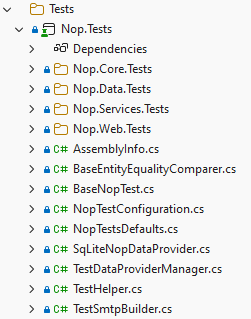
In the screenshot, you can see the structure of the Nop.Tests project. The folders such as Nop.Core.Tests contain tests for the corresponding projects of the solution. The other files are responsible for the auxiliary and base classes. Let's look at the BaseNopTest class.
BaseNopTest
This is the main static class that exposes the IoC container for tests and allows us to use all the advantages of DI.
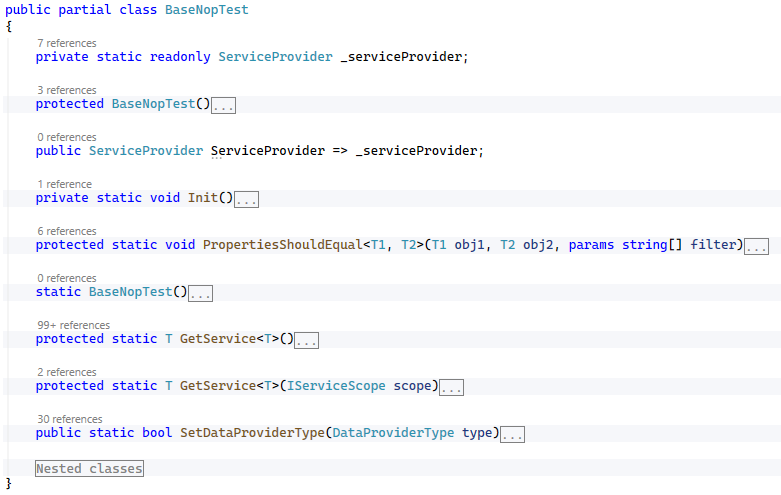
This class contains two methods available for child classes:
PropertiesShouldEqualthat compares all fields of the database entity with the fields of the model.GetServicethat allows using the advantages of DI and relieves creating the classes necessary for testing.
The initialization of the IoC container is carried out in the static constructor of the class; this constructor contains the bulk of the code.
IScheduleTaskService
As an example, we will create tests for a class that implements the IScheduleTaskService interface.
public partial interface IScheduleTaskService
{
    System.Threading.Tasks.Task DeleteTaskAsync(ScheduleTask task);

    Task<ScheduleTask> GetTaskByIdAsync(int taskId);

    Task<ScheduleTask> GetTaskByTypeAsync(string type);

    Task<IList<ScheduleTask>> GetAllTasksAsync(bool showHidden = false);

    System.Threading.Tasks.Task InsertTaskAsync(ScheduleTask task);

    System.Threading.Tasks.Task UpdateTaskAsync(ScheduleTask task);
}
As you can see this is a simple interface. But at the same time, it allows nopCommerce to perform very important tasks such as sending email messages to customers. So we need to be sure that it works properly. Next, we will write tests for each of the interface methods.
Note
We don't use TDD but we are not against this approach. The reliability of the functionality is important for us, not a specific approach to testing.
ScheduleTaskServiceTests class
Add a new ScheduleTaskServiceTests class to the project (Nop.Tests\Nop.Services.Tests\Tasks). Its code is shown below:
using NUnit.Framework;

namespace Nop.Tests.Nop.Services.Tests.Tasks
{
    [TestFixture]
    public class ScheduleTaskServiceTests : ServiceTest
    {
    }
}
This is the class template for testing. From this code, we can see that nopCommerce uses the NUnit framework for tests. There are two points to pay attention to:
- Our class has the TestFixture attribute which tells the engine that this class is a class with tests.
- We do not directly inherit the
BaseNopTestclass but inherit another abstract class -ServiceTestwhich adds the main plugins to the configuration.
The next step is to add a method for the initialization of our tests. As a rule, such a method is called SetUp. In this method, we get an instance of a class that implements the IScheduleTaskService interface, which we will test.
private IScheduleTaskService _scheduleTaskService;

[OneTimeSetUp]
public void SetUp()
{
    _scheduleTaskService = GetService<IScheduleTaskService>();
}
As you can see, the SetUp method should be declared with the OneTimeSetUp attribute as well as you may use the SetUp attribute. The difference between these two attributes is only the number of calls to the method itself: in the first case, the SetUp method is called once for all tests, and in the second, for each test separately.
Next, let's add tests for CRUD methods. In this service, these are methods such as: InsertTaskAsync, GetTaskByIdAsync, UpdateTaskAsync, and DeleteTaskAsync.
But first, let's add one more field to the class. This will be an instance of the ScheduleTask class which will be used for testing:
private ScheduleTask _task;
Update the SetUp method the following way:
[OneTimeSetUp]
public void SetUp()
{
   _scheduleTaskService = GetService<IScheduleTaskService>();

   _task = new ScheduleTask { Enabled = true, Name = "Test task", Seconds = 60, Type = "nop.test.task" };
}
All CRUD testing methods are given below and as you can see there is nothing complicated in them:
#region CRUD tests

[Test]
public async System.Threading.Tasks.Task CanInsertAndGetTask()
{
    _task.Id = 0;
    await _scheduleTaskService.InsertTaskAsync(_task);
    var task = await _scheduleTaskService.GetTaskByIdAsync(_task.Id);
    await _scheduleTaskService.DeleteTaskAsync(_task);

    _task.Id.Should().NotBe(0);
    task.Id.Should().Be(_task.Id);
    task.Name.Should().Be(_task.Name);
}

[Test]
public void InsertTaskShouldRaiseExceptionIfTaskIsNull()
{
    Assert.Throws<AggregateException>(() =>
            _scheduleTaskService.InsertTaskAsync(null).Wait());
}

[Test]
public async System.Threading.Tasks.Task GetTaskByIdShouldReturnNullIfTaskIdIsZero()
{
    var task = await _scheduleTaskService.GetTaskByIdAsync(0);
    task.Should().BeNull();
}

[Test]
public async System.Threading.Tasks.Task GetTaskByIdShouldReturnNullIfTaskIdIsNotExists()
{
    var task = await _scheduleTaskService.GetTaskByIdAsync(int.MaxValue);
    task.Should().BeNull();
}

[Test]
public async System.Threading.Tasks.Task CanUpdateTask()
{
    _task.Id = 0;
    await _scheduleTaskService.InsertTaskAsync(_task);
    var task = await _scheduleTaskService.GetTaskByIdAsync(_task.Id);
    task.Name = "new test name";
    await _scheduleTaskService.UpdateTaskAsync(task);
    var task2 = await _scheduleTaskService.GetTaskByIdAsync(_task.Id);
    await _scheduleTaskService.DeleteTaskAsync(_task);

    task.Id.Should().Be(task2.Id);
    task2.Name.Should().NotBe(_task.Name);
}

[Test]
public void UpdateTaskShouldRaiseExceptionIfTaskIsNull()
{
    Assert.Throws<AggregateException>(() =>
        _scheduleTaskService.UpdateTaskAsync(null).Wait());
}

public async System.Threading.Tasks.Task CanDeleteTask()
{
    _task.Id = 0;
    await _scheduleTaskService.InsertTaskAsync(_task);
    await _scheduleTaskService.DeleteTaskAsync(_task);
    var task = await _scheduleTaskService.GetTaskByIdAsync(_task.Id);
    task.Should().BeNull();
}

[Test]
public void DeleteTaskShouldRaiseExceptionIfTaskIsNull()
{
    Assert.Throws<AggregateException>(() =>
        _scheduleTaskService.DeleteTaskAsync(null).Wait());
}

#endregion
In addition, the list of connected namespaces has been changed. The updated list is provided below:
using System;
using FluentAssertions;
using Nop.Core.Domain.Tasks;
using Nop.Services.Tasks;
using NUnit.Framework;
Note
We have to delete all changes made by a test from the database. In our case, we use the DeleteTaskAsync method for this purpose. Also, note that it should be done just before we call test methods such as task.Should().BeNull();, task2.Name.Should().NotBe(_task.Name); etc. because if the test fails, the database will contain data that can affect other testing processes.
Then let's test the two remaining methods:
[Test]
public async System.Threading.Tasks.Task CanGetTaskByType()
{
    _task.Id = 0;
    var task = await _scheduleTaskService.GetTaskByTypeAsync(_task.Type);
    task.Should().BeNull();
    await _scheduleTaskService.InsertTaskAsync(_task);
    task = await _scheduleTaskService.GetTaskByTypeAsync(_task.Type);
    await _scheduleTaskService.DeleteTaskAsync(_task);
    task.Should().NotBeNull();
}

[Test]
public async System.Threading.Tasks.Task GetTaskByTypeShouldReturnNullIfTypeIsNull()
{
    var task = await _scheduleTaskService.GetTaskByTypeAsync(null);
    task.Should().BeNull();
}

[Test]
public async System.Threading.Tasks.Task GetTaskByTypeShouldReturnNullIfTypeIsEmpty()
{
    var task = await _scheduleTaskService.GetTaskByTypeAsync(string.Empty);
    task.Should().BeNull();
}

[Test]
public async System.Threading.Tasks.Task CanGetAllTasks()
{
    _task.Id = 0;
    var tasks = await _scheduleTaskService.GetAllTasksAsync(true);
    tasks.Count.Should().Be(0);
    tasks = await _scheduleTaskService.GetAllTasksAsync(false);
    tasks.Count.Should().Be(0);

    await _scheduleTaskService.InsertTaskAsync(_task);
    var tasksWithHidden = await _scheduleTaskService.GetAllTasksAsync(true);
    var tasksWitoutHidden = await _scheduleTaskService.GetAllTasksAsync(false);
    await _scheduleTaskService.DeleteTaskAsync(_task);

    tasksWithHidden.Count.Should().Be(1);
    tasksWitoutHidden.Count.Should().Be(1);

    _task.Enabled = false;

    await _scheduleTaskService.InsertTaskAsync(_task);
    tasksWithHidden = await _scheduleTaskService.GetAllTasksAsync(true);
    tasksWitoutHidden = await _scheduleTaskService.GetAllTasksAsync(false);
    await _scheduleTaskService.DeleteTaskAsync(_task);
    _task.Enabled = true;

    tasksWithHidden.Count.Should().Be(1);
    tasksWitoutHidden.Count.Should().Be(0);
}
Finally, let's add one more standard method for many tests which is usually called TearDown. In this method, we will carry out the final cleaning of the database for possible changes made by us during the testing process. This method must have the OneTimeTearDown or TearDown attribute, similar to the attributes of the SetUp method.
[OneTimeTearDown]
public async System.Threading.Tasks.Task TearDown()
{
    var tasks = await _scheduleTaskService.GetAllTasksAsync(true);

    foreach (var task in tasks.Where(t=>t.Type.Equals(_task.Type, StringComparison.InvariantCultureIgnoreCase)))
        await _scheduleTaskService.DeleteTaskAsync(task);
}
That's it, our test class is ready! As promised at the beginning, you can find all the materials via the links below:
- Full Source Code: ScheduleTaskServiceTests — the final version of the test class in the repository.
- Git Commit — the exact commit showing all additions and changes.


